

Are You Making These 3 Common Cooling Mistakes in the Colorado Heat?
Are You Making These 3 Common Cooling Mistakes in the Colorado Heat?
July in Colorado Springs brings a unique kind of heat that every driver feels the moment they step onto the asphalt. While the thermometer might read 90 degrees, the combination of intense high-altitude sun and thin mountain air creates a brutal environment for your vehicle. At McCloskey Motors, we see it every summer: dependable cars that run perfectly at sea level suddenly struggle when they have to climb Ute Pass or navigate the stop-and-go traffic on N. Academy Blvd.

The truth is that our local environment is a stress test for your engine cooling system. Whether you are driving one of the many trucks for sale in colorado springs co or a family SUV, your vehicle has to work harder here than almost anywhere else in the country. Because the air is thinner at 6,035 feet, it is less efficient at carrying heat away from your radiator. When you add a steep grade or a heavy trailer into the mix, a small cooling system weakness can quickly turn into a major repair bill.
Here is what most drivers in the Springs overlook when the summer heat peaks.
The Altitude Factor: Why Colorado Is Different
Before we dive into the mistakes, it is important to understand why our geography matters. In places like Florida or Texas, humidity is the enemy. In Colorado, it is the lack of air density. Your radiator relies on billions of air molecules passing through its fins to pull heat away from the coolant. At our elevation, there are simply fewer molecules available to do that job.
This means your cooling system is already operating at a disadvantage. If you are shopping at used car lots in colorado springs, you need a vehicle that has been maintained specifically for these conditions. A cooling system that is 90 percent effective might get by in the Midwest, but it will fail you halfway up the Pikes Peak Highway.
Mistake 1: The "I Will Just Top It Off" Coolant Trap
One of the most common errors we see at our service center is drivers neglecting their coolant levels or using the wrong mixture. Many people believe that as long as there is liquid in the reservoir, the car is fine. However, the quality and type of that liquid are critical.
The Problem With Plain Water
In an emergency, plain water can get you home. But leaving it in your system is a recipe for disaster in the Colorado heat. Water has a lower boiling point than a proper 50/50 coolant mix. At high altitudes, the atmospheric pressure is lower, which actually lowers the boiling point of liquids even further. If your system is mostly water, it can begin to boil and turn into steam inside your engine block long before a proper mixture would. Steam does not transfer heat; it traps it.
Ignoring the Coolant Age
Coolant is not just for preventing freezes. It contains rust inhibitors and lubricants for your water pump. Over time, these chemicals break down. In the intense heat of a Colorado summer, old coolant can become acidic or develop "drop-out," which is when minerals solidify and start to clog the narrow passages in your engine.
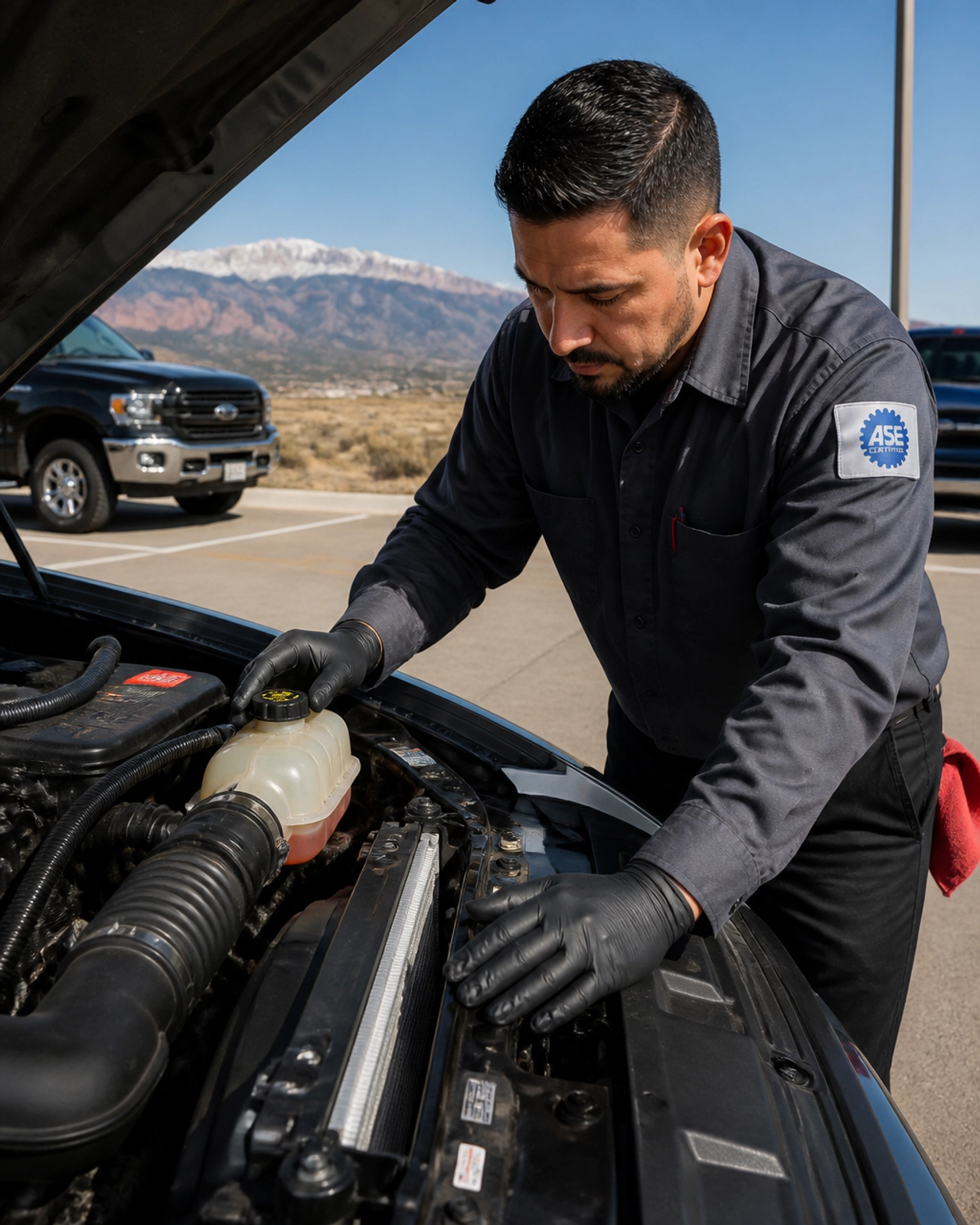
Mistake 2: Ignoring the "Silent Choke" of Colorado Dust
If you live near Cimarron Hills, Black Forest, or any of our newer construction areas, your car is constantly breathing in fine granite dust and debris. This dust does not just dirty your paint; it migrates into the tiny fins of your radiator and Air Conditioning (AC) condenser.
The Clogging Effect
Your radiator and AC condenser sit right at the front of your vehicle. They act like a giant net for everything the wind carries. Over a few seasons, a layer of dust, dried mud, and sand from our winter road treatments can build up. This creates a literal blanket over the cooling fins.
This "silent choke" reduces the surface area available for cooling. You might not notice it while cruising down I-25 at 65 miles per hour because the high speed forces enough air through the remaining gaps. However, the moment you slow down in traffic or start a slow climb toward Woodland Park, the temperature gauge will start to creep up.
The AC Connection
Many drivers do not realize that their AC condenser is usually mounted directly in front of the radiator. If the condenser is clogged with dust, it cannot shed heat from the AC system. This heat then washes directly over the radiator, making it even harder for the engine to stay cool. If your AC feels weak when you are stopped at a light but cold when you are moving, a clogged condenser is often the culprit.

Mistake 3: Waiting for the Needle to Spike Before Acting
This is perhaps the most dangerous mistake a driver can make. Modern cars are designed to keep the temperature needle right in the middle of the gauge. By the time that needle starts moving toward the red zone, your engine is already significantly hotter than it should be.
The Thermal Lag
There is a delay between the engine getting too hot and the sensor reflecting that change on your dashboard. If you wait until the light flashes or steam appears, you are already risking a warped cylinder head or a blown head gasket. These are multi-thousand dollar repairs that could often be avoided by pulling over five minutes earlier.
The Right Way to React
If you notice the needle moving even a small amount past its normal position, take immediate action:
- Turn off the AC immediately. This reduces the load on the engine and stops the condenser from dumping heat onto the radiator.
- Turn on the cabin heater to the highest setting and full blast. It is uncomfortable in July, but your heater core acts like a mini-radiator that pulls heat away from the engine.
- If the temperature does not drop within a minute, pull over safely.
- Do not shut the engine off immediately if you see steam. If it is safe, let it idle for a moment to keep the coolant circulating, then shut it down.
- Never, under any circumstances, open the radiator cap while the engine is hot. The pressurized steam can cause life-altering burns.
Keeping Your Work Vehicle Cool
For those looking for cargo vans for sale colorado springs, cooling is even more critical. Work vans and trucks often carry heavy payloads or tow trailers, which places a massive thermal load on the engine. If you are running a business, a breakdown on the side of the road is more than just an inconvenience; it is lost revenue. At McCloskey Motors, we specialize in high-quality pre-owned work vehicles that are inspected to handle the rigors of El Paso County terrain.
Our truck dealerships in colorado springs focus on vehicles that have been properly vetted. We check for signs of cooling system stress, such as brittle hoses or mineral deposits, before any truck or van hits our lot.

Frequently Asked Questions About Cooling Systems
How often should I flush my coolant in Colorado?
While many manufacturers suggest long intervals, the extremes of Colorado driving often warrant a flush every two to three years or every 30,000 miles. This ensures the pH balance stays correct and prevents internal corrosion.
Why does my car only run hot when I am going uphill?
Climbing requires more fuel and creates more combustion heat. At the same time, your vehicle speed is often lower, meaning there is less "ram air" hitting the radiator. If your system is marginal due to a partial clog or a weak water pump, the uphill climb is where it will show its face.
Can a bad radiator cap cause overheating?
Yes. The cap is designed to hold the system under a specific amount of pressure. This pressure raises the boiling point of the coolant. If the seal on the cap is worn, the system loses pressure, the coolant boils at a lower temperature, and the engine overheats.
Is it normal for the fan to stay on after I turn the car off?
In the heat of a Colorado summer, yes. Modern vehicles often keep the electric cooling fans running for a few minutes after shutdown to prevent "heat soak," which is when the temperature of the stagnant coolant rises because the water pump is no longer moving it.
Your Partner for Summer Driving Success
At McCloskey Motors and McCloskey Imports & 4x4's, we have been helping Colorado Springs drivers stay on the road for decades. We are an 8-time winner of the BBB Excellence in Customer Service Award because we treat our customers like neighbors. With over 200 vehicles in stock and an average of 4.7 stars across 10,000 plus reviews, we know what it takes to provide reliable transportation in the Rockies.
If you are concerned about your current vehicle's cooling system, or if you are in the market for auto sales colorado springs, our team is here to help. We offer flexible in-house financing and a state-of-the-art service center to keep your vehicle in top condition long-term.
Do not let a preventable cooling mistake ruin your summer adventures. Whether you are heading to the Royal Gorge or just commuting to Fort Carson, a little maintenance goes a long way.
Browse our current inventory or schedule a cooling system check at BigJoeAuto.com today.
McCloskey Motors / McCloskey Imports & 4x4's 6710 N. Academy Blvd, Colorado Springs, CO 80918 (719) 685-7000 BigJoeAuto.com